Saidot workflows and automation features
Saidot enables trigger-based AI governance processes and workflows. Workflows are created and run on a Space level allowing to design Space-specific configurations. Workflows have a template that can be used and edited when creating the workflow. Workflows can be viewed by all Saidot members.
Saidot has currently templates for:
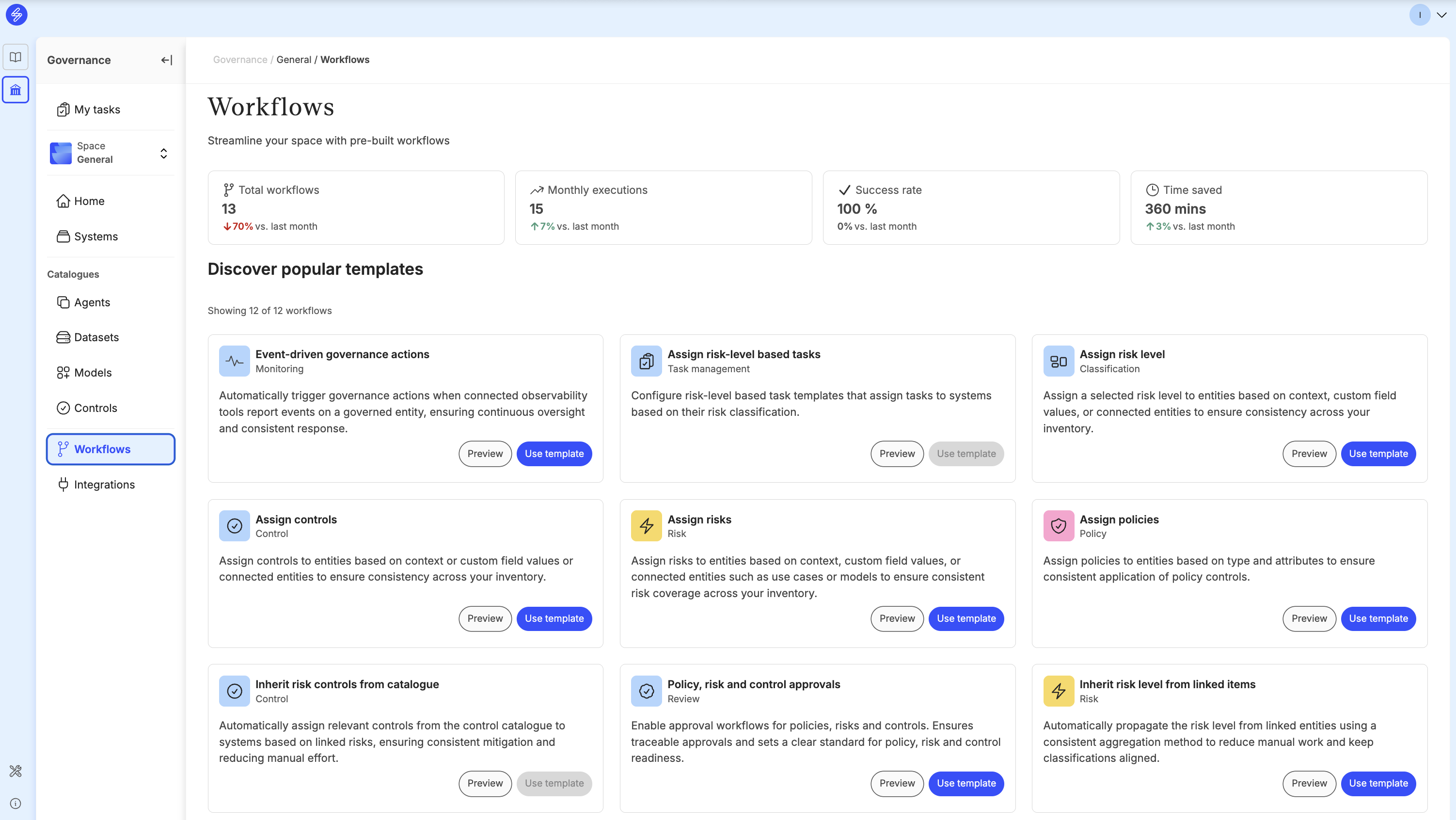
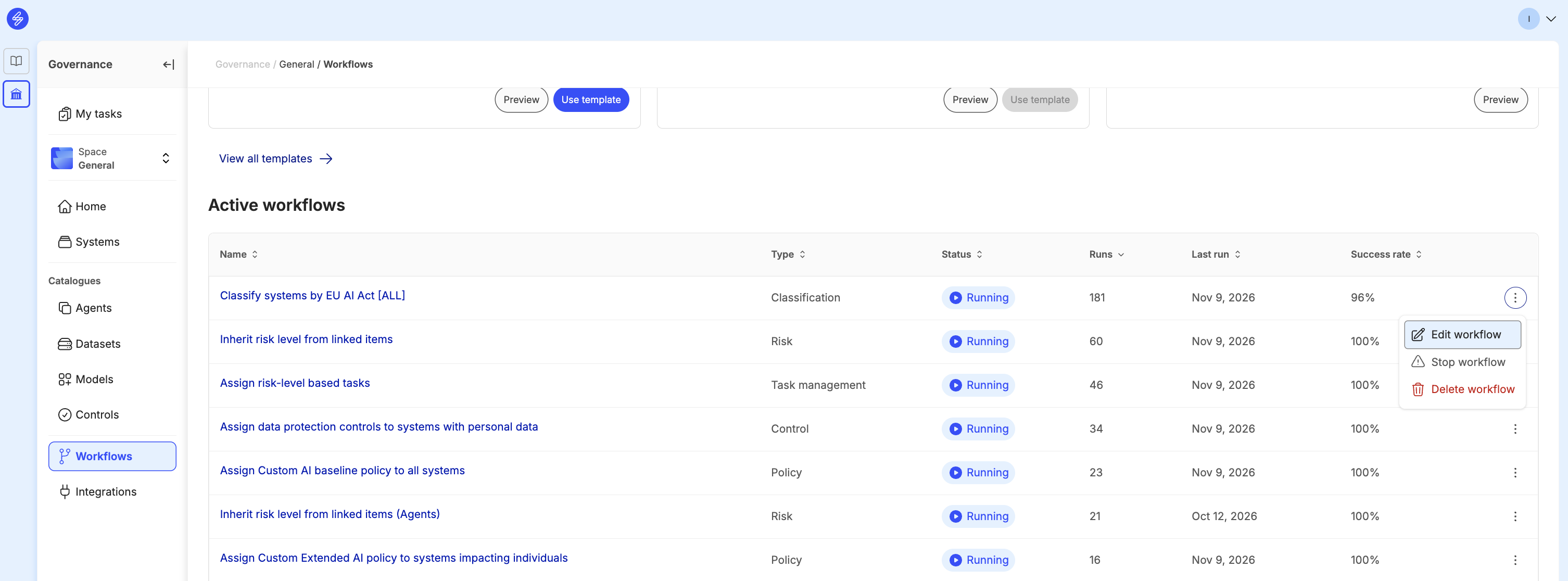
The Workflows view has insights about the number of active automations, monthly executions, success rate and the total time saved with automations. Saidot Admins and Space managers can create, pause, edit and delete automations.
The ability to create impactful assignment workflows is dependent on
-
What kind of Custom fields have been defined as gating or tiering questions
-
Are the gating questions answered in System Context section or for linked Models, Agents, Tools and Datasets
-
How the organisation is using widgets, including Customers, Suppliers and Use cases
-
Is the organisation using the AI Act Classifier that can also be used in assignment rules
Examples of common gating and tiering fields for assignment rules
|
Custom field |
Typical answer options |
What a workflow can assign |
|---|---|---|
|
User exposure |
Internal only / External (customer-facing) / Public |
Transparency controls, disclosure tasks, reputational risks |
|
Decisions about individuals |
None / Supports decisions / Makes decisions automatically. Follow-up: which area (employment, credit, insurance, education, access to services) |
High risk level, EU AI Act Annex III screening, fundamental rights impact assessment, human oversight controls |
|
Personal data |
None / Personal data / Special category data |
GDPR policy, DPIA task, privacy risks and controls |
|
Human control level |
Human in the loop / Human on the loop / Fully automated |
Human oversight controls, approval requirements |
|
Autonomy and actions |
Read-only / Can act in other systems / Acts without approval |
Agent controls such as least-privilege tool access, human approval for high-impact actions, action logging |
|
Generated content |
No / Internal content / Published or customer-facing content |
Content marking controls, IP and copyright risks, hallucination risks |
|
Sourcing |
Built in-house / Fine-tuned / Bought from a vendor |
Provider or deployer obligations, third-party vendor assessment controls |
|
Business criticality |
Low / Medium / High |
Risk level or business impact level, review frequency, stage approvals |
|
Regulated domain |
None / Financial services / Healthcare / Critical infrastructure |
Sector policies, such as internal model risk management, plus extra review tasks |
|
Data confidentiality |
Public / Internal / Confidential / Restricted |
Security controls, information security review task |
A typical rule then reads: IF Decisions about individuals = Makes decisions automatically AND Personal data = Special category data, THEN assign risk level High, the GDPR DPIA task and the human oversight controls.
Classify systems by EU AI Act
Saidot enables automation of AI Act classification. The Admin can select to trigger the AI Act classification for all systems or systems on a specific region. Once the automation has been created, AI Act Classification is triggered to the new systems that meet this criteria. AI Act classification can also be triggered to previously created systems after an item in the system overview is edited.

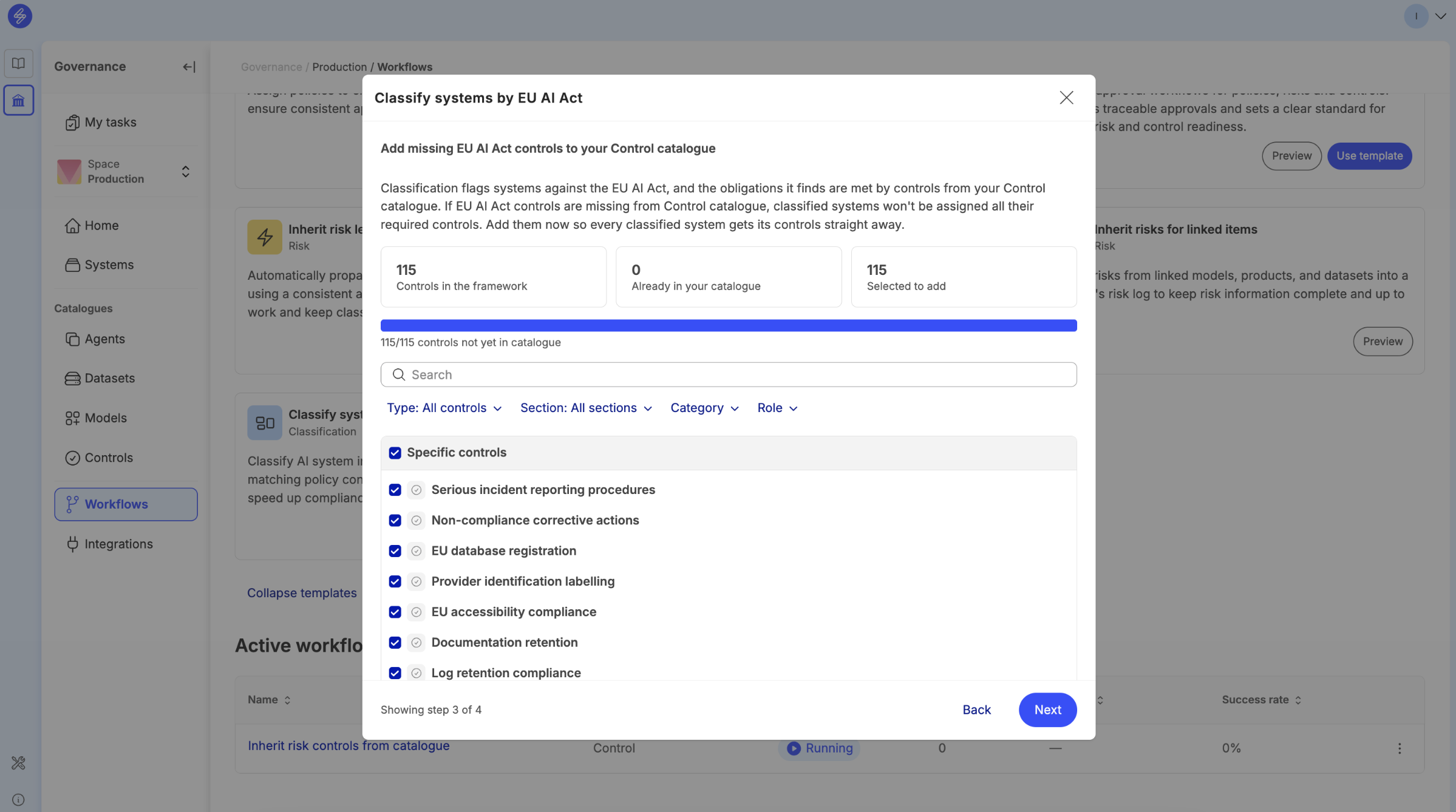
Classification flags systems against the EU AI Act, and the obligations it finds are met by controls from your Control Catalogue. If EU AI Act controls are missing from your catalogue, classified systems won't be assigned all their required controls. That's why the workflow setup includes a step for adding the missing controls.
In step 3 of 4, Add missing EU AI Act controls to your Control catalogue, you'll see:
-
Controls in the framework: the total number of EU AI Act controls
-
Already in your catalogue: how many of them your Space already has
-
Selected to add: how many missing controls will be added
All missing controls are selected by default. Use Search and the Type, Section, Category and Role filters to review them, and clear any you don't want to add. Select Next to continue. We recommend adding all missing controls so that every classified system gets its required controls straight away.
One the AI Act Classification automation has been created, the AI Act Classification becomes visible in the AI system overview page. You can learn more about AI Act Classification here.
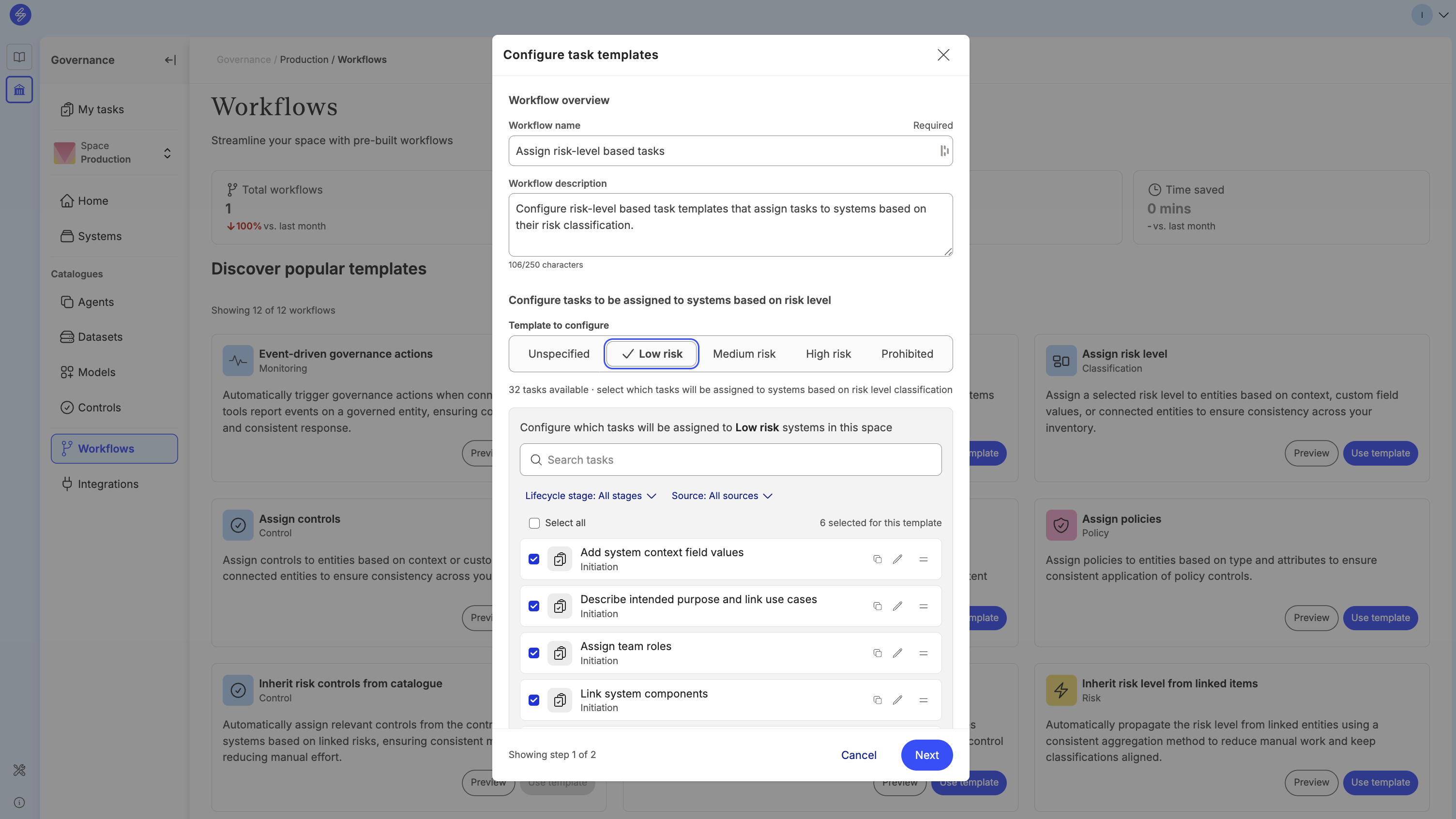
Assign risk-level based tasks
This workflow allows you to configure the AI governance process tasks for each lifecycle stage and risk level. Pick a risk level, select the tasks that systems at that level should receive, and repeat for each level. When you activate the workflow, your systems generate their task sets, and your users then see their own work in My tasks at the top of the Governance navigation and on each system's Tasks tab. You can learn more about Tasks here.
Assign tasks
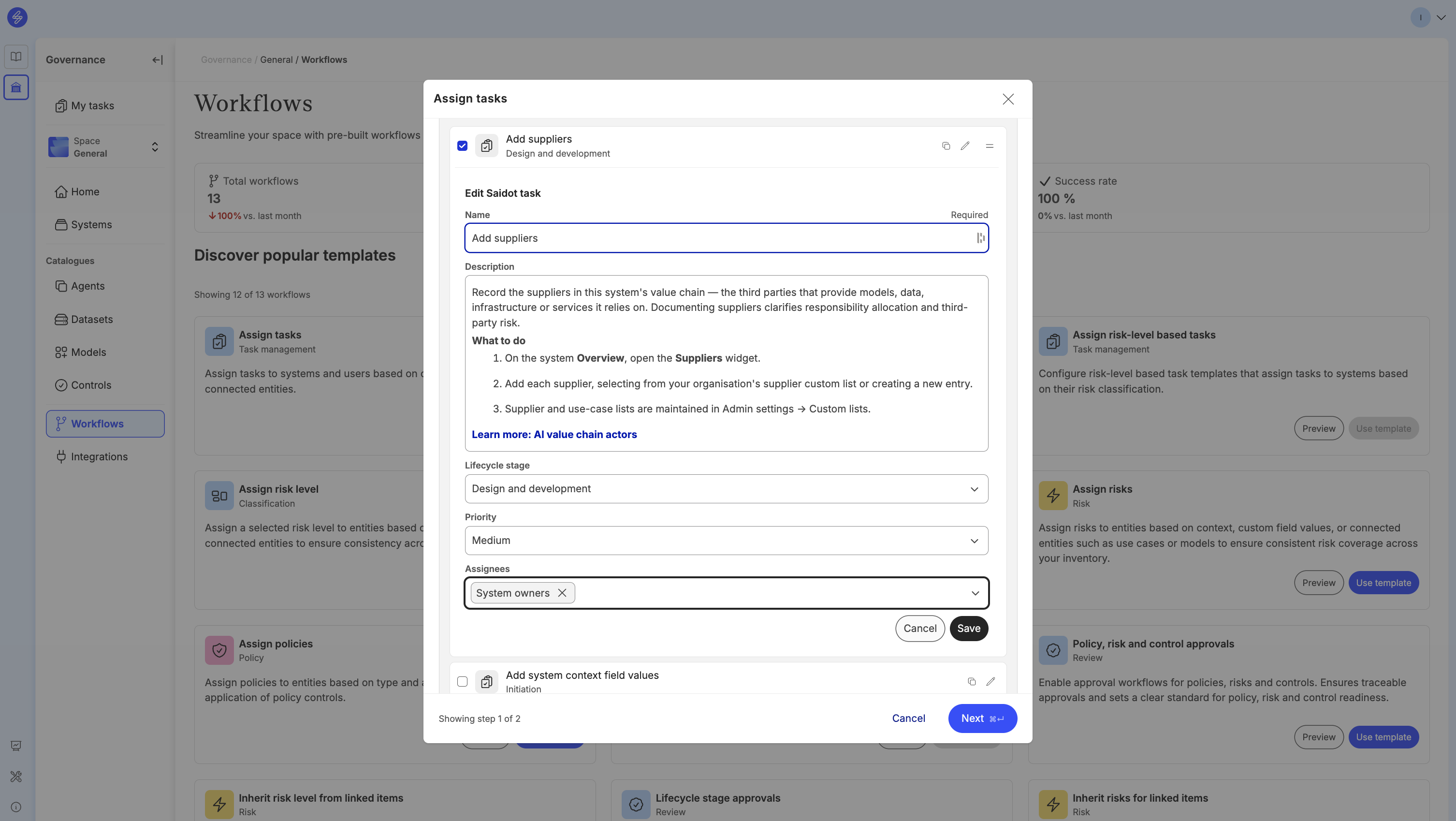
This workflow assigns governance tasks to systems and users based on context, custom field values or connected entities. Unlike Assign risk-level based tasks, it isn't tied to a system's risk classification, so you can target tasks at any group of systems you define.
Step 1. Select task
Select the tasks you want to assign to Systems. You can edit the task description, lifecycle stage, priority and assignee during this step.
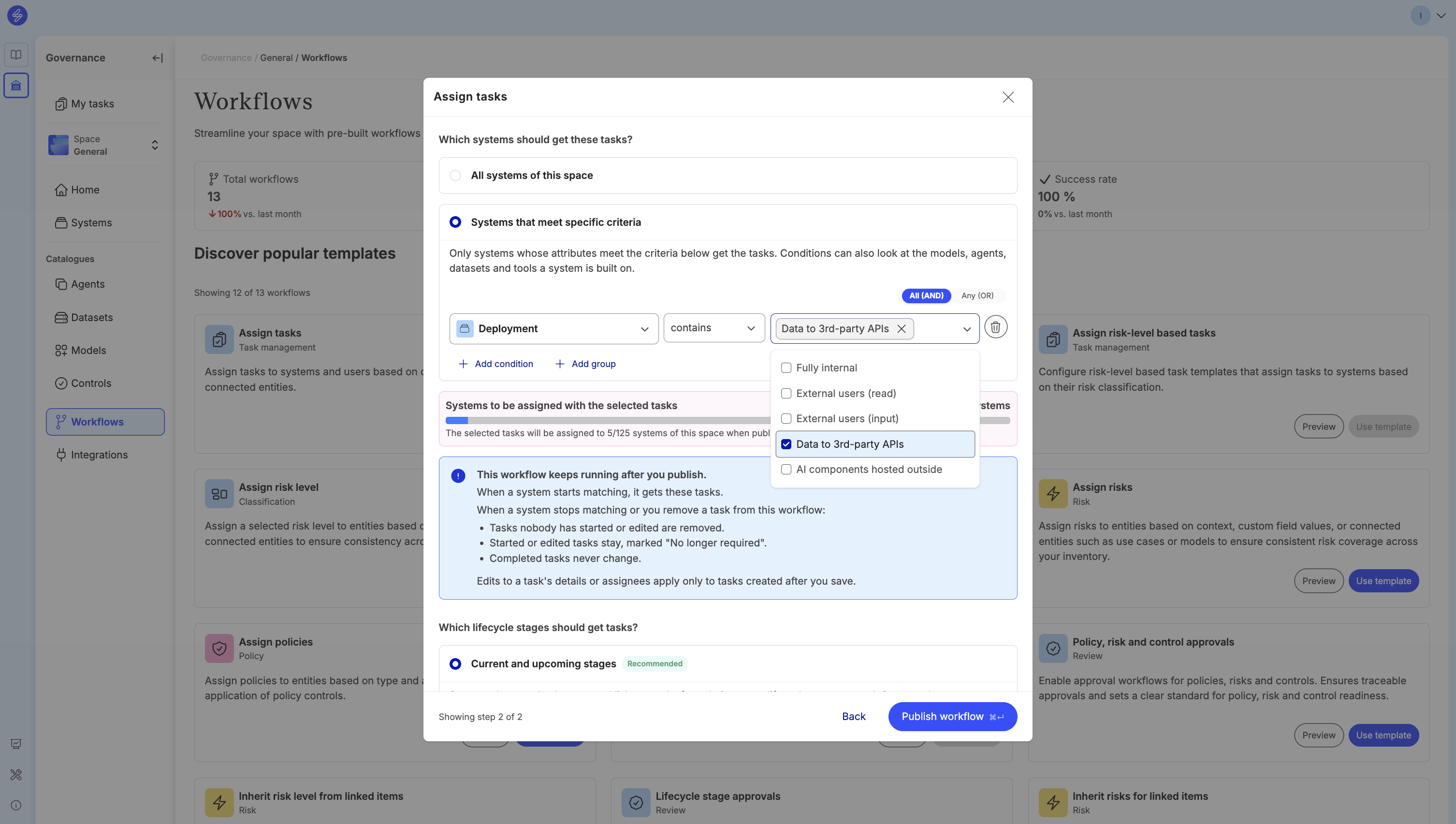
Step 2. Define the system criteria
Define the System’s Context or Component field values that set the specific criteria for the task assignment.
Event-driven governance actions
This workflow maps observability events to governance actions. When a connected observability tool reports an event on a governed entity, Saidot runs the actions you've configured, so oversight is continuous and responses are consistent.
To set it up, go to Workflows and select Use template on Event-driven governance actions. The setup has three steps.
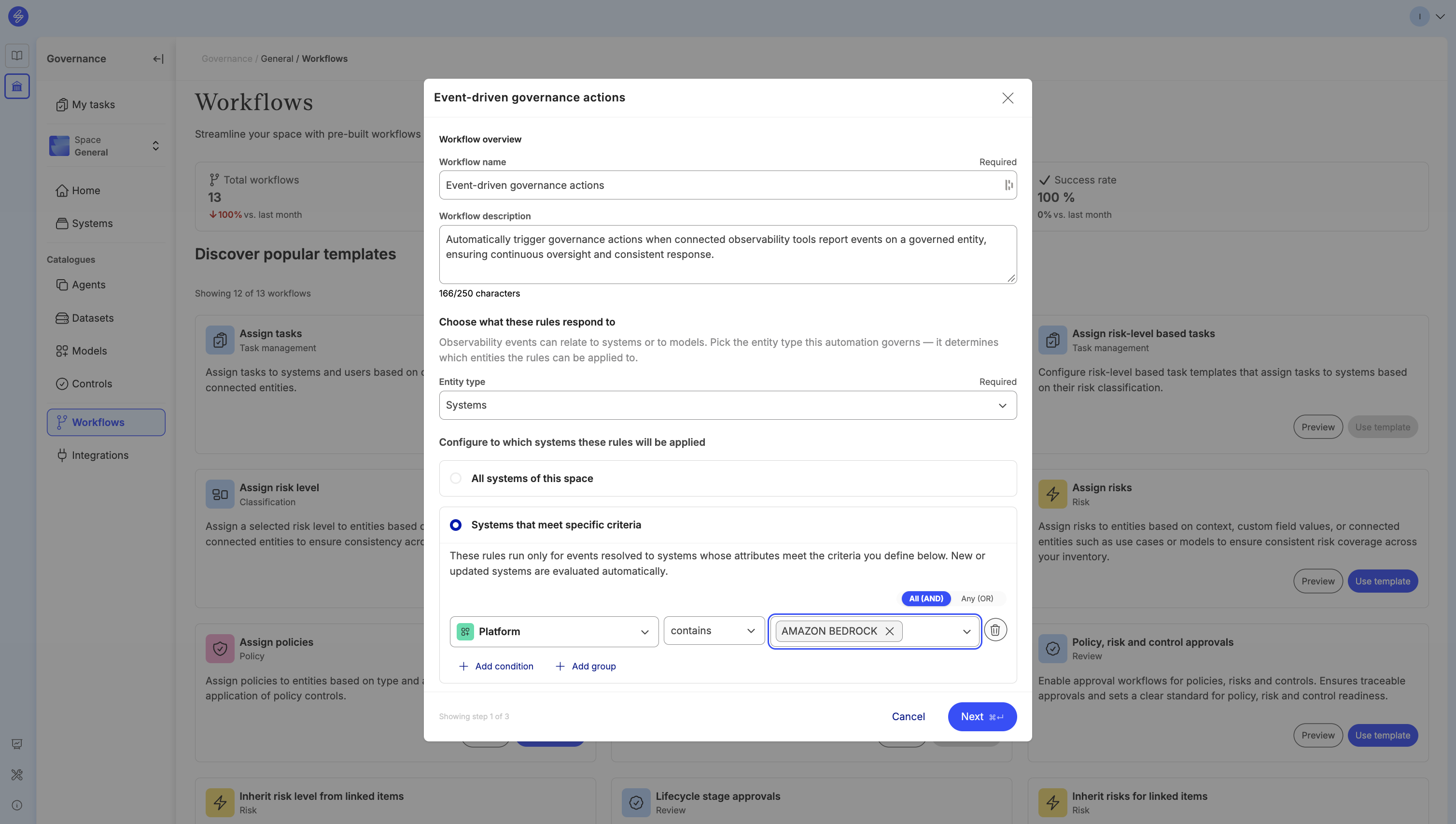
Step 1. Scope. Give the workflow a name and description, then:
-
Choose the Entity type the rules respond to: Systems or Models. Observability events can relate to either, and the entity type decides which entities the rules can be applied to.
-
Choose where the rules apply: All systems of this space, or Systems that meet specific criteria. With criteria, the rules run only for events resolved to systems whose attributes match, for example Platform contains Amazon Bedrock. Combine conditions with All (AND) or Any (OR), and use Add condition and Add group to build them. New or updated systems are evaluated automatically.
-
Check Systems to be assigned with these rules, which shows how many systems match before you publish, for example 11 of 123.
Step 2. Events and actions. Turn on the events the workflow should respond to, then pick the actions and the severity each one needs. Examples of event types that are supported:
|
Event |
What it means |
|---|---|
|
Performance deviation detected |
Operational performance deviations outside pre-defined thresholds |
|
Data drift detected |
Shifts in data distributions relative to training data |
|
Security incident detected |
Indicators of adversarial attacks or malicious activity targeting AI systems |
|
Adverse event recorded |
An adverse outcome or harm attributed to the AI system has been recorded |
|
Inference trace logged |
An inference trace has been captured and logged for audit or explainability purposes |
|
Security event recorded |
A security-relevant event has been logged by the monitoring platform |
|
New model selected |
A new model version has been selected for deployment |
|
New model deployed |
A new model version has been deployed to production |
|
New model created or updated |
A new model has been created or an existing model has been significantly updated |
|
Patch update applied |
A patch or minor update has been applied to the AI system |
|
Guardrail or business logic updated |
A guardrail configuration or business logic rule governing the AI system has been modified |
|
Lifecycle stage changed |
The AI system has transitioned to a new lifecycle stage |
|
Ramp milestone reached |
A staged rollout milestone has been reached (e.g. 10%, 50%, 100% traffic) |
|
Human review practice changed |
The human review or oversight practice for an AI system has been modified |
|
System metadata updated |
System or model metadata, tagging, or descriptive attributes have been updated in Saidot |
|
Risk level increased |
The risk rating for a system or model has been escalated in Saidot |
|
Use case type updated |
The use case classification or type designation for a system or model has been changed |
|
Personal data category updated |
The categories of personal data processed by the AI system have been updated |
|
Conformance enforcement check performed |
An automated conformance check was executed against governance controls |
|
Non-conformant change blocked |
A change that would violate governance controls was blocked by the conformance engine |
|
Version incremented |
A system or model version number was incremented following a governance-tracked change |
For each event you turn on, select the actions to run:
-
Create incident
-
Notify owner
-
Fire webhook
-
Increase system risk level
-
Move to re-evaluate
-
Create review
Each action has a severity threshold (when severity ≥). An action runs only for events at or above that level, for example High+, or for Any severity.
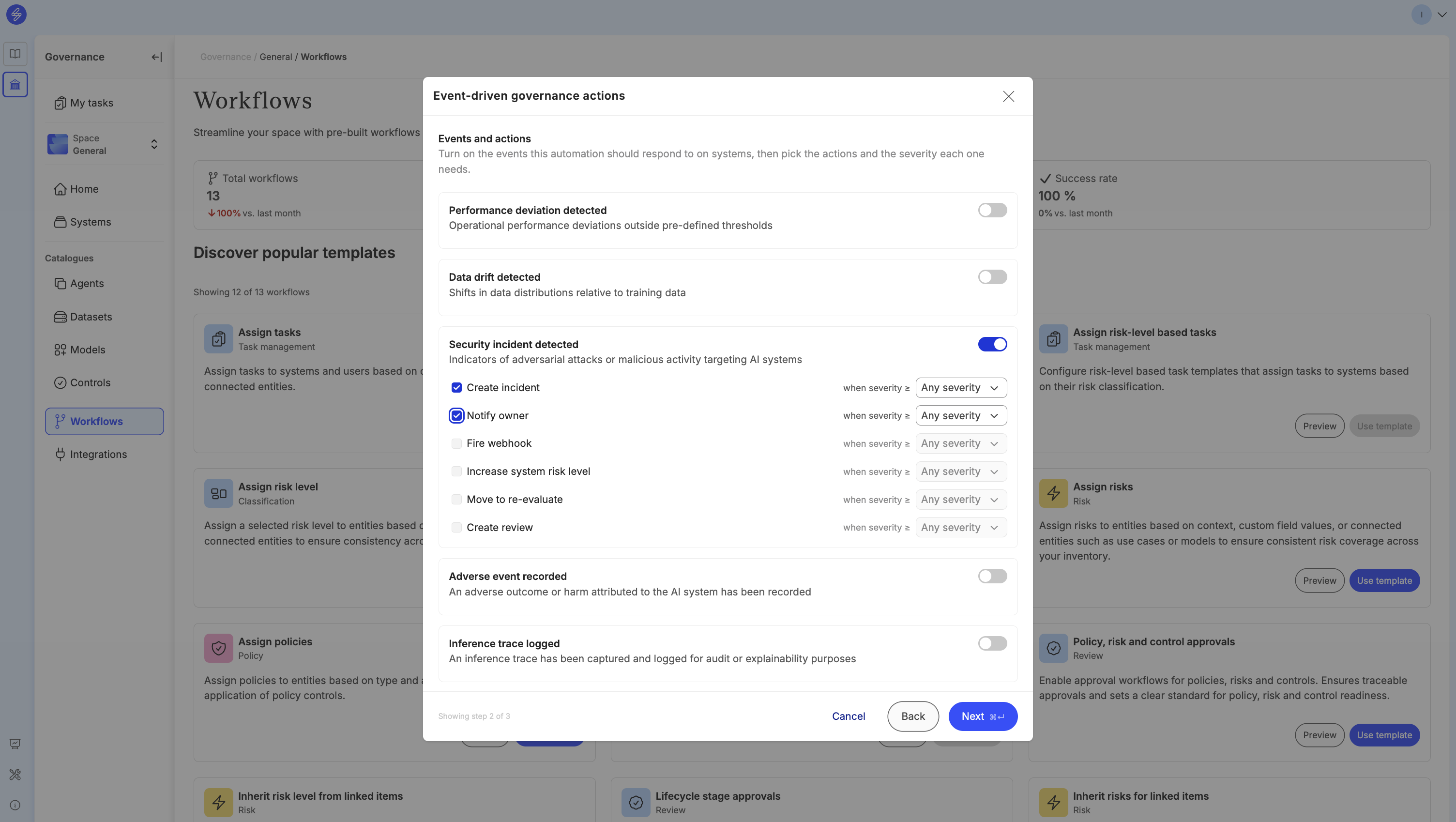
Step 3. Review. Check the summary before you save. It shows which systems the workflow is limited to, for example systems where Platform contains Amazon Bedrock. It also lists each event you turned on with its actions and severities, for example New model deployed: Notify owner at any severity, Move to re-evaluate at any severity. Select Back to change anything, or Save rules to activate the workflow.
Good practice: switch event types on per system class, with thresholds agreed with your second line. Make sure every event lands on a governed asset by mapping each system or model to its ID in your monitoring platform. Treat webhook consumers as production integrations. Automated actions create, notify and route work, and can raise a risk level or reopen an approved system. Closing the review, confirming the treatment and approving the system's return to operation stay with a named owner.
Inherit risks for linked items
This automation template is set on as a default at Saidot. The automation allows risks to be inherited from to System Risks when a Model, Data or a Product is linked to the System Components. The risks are inherited to the AI System from these items:
-
Model Library item
-
Product Library item
-
Model Catalogue and Model Card
-
Dataset Catalogue and Dataset Card

The inherited risks will be displayed in the AI System Risk tab with an icon indicating the risk source. More information about managing the inherited risks in the AI System context can be found here.
Lifecycle stage approvals
This automated workflow is used to add an approval step for elected lifecycle stages. Admins and Space Managers can configure the approval request as mandatory step before Deployment decision. Typically the approver of the Lifecycle stage is set to be the Reviewer of the System. In this case, the System team needs to have a Team member assigned as a reviewer.

All System team members can ask for Approval when attempting to move the system to the set Lifecycle stage.

When Approval has been requested, the System Lifecycle stage is not changed and marked with Pending approval status.

Set up policy and control approvals
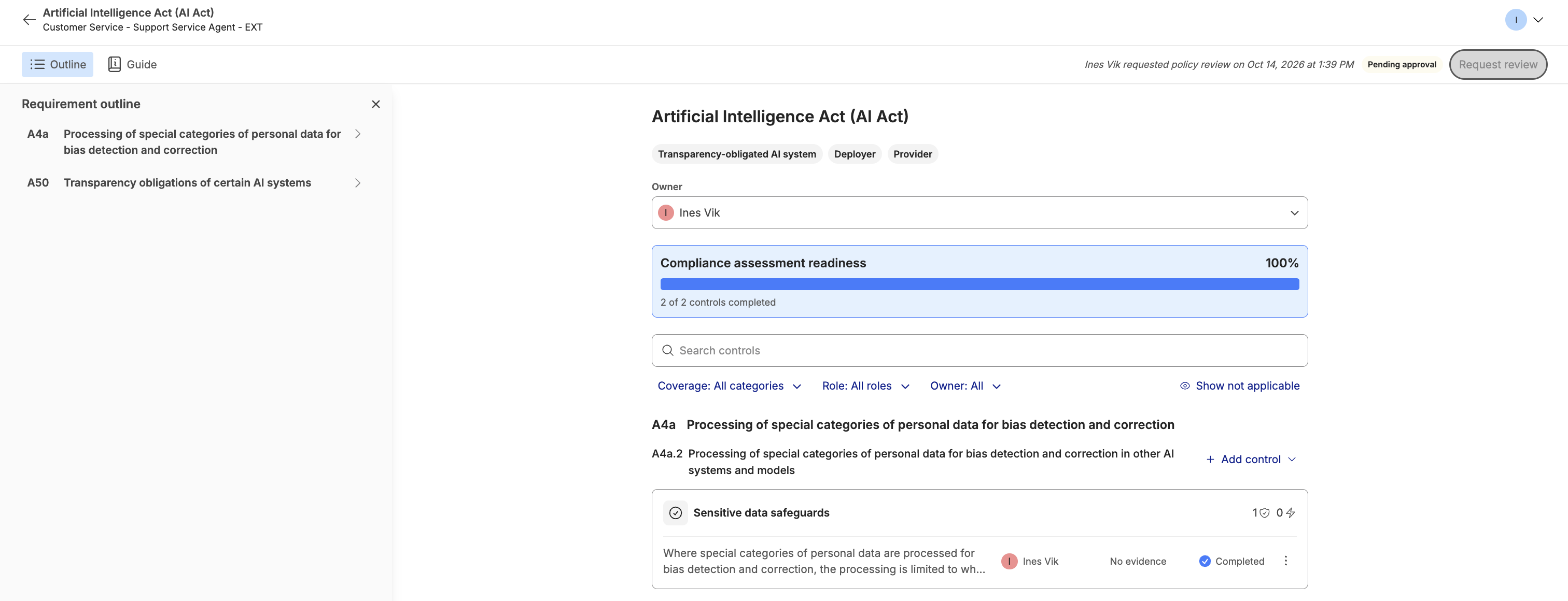
This automated workflow is used to add an approval step for policies and controls. Admins and Space Managers can configure the approval request on a control or policy level. Typically the approver of the Policy or Control is set to be the Reviewer of the System. In this case, the System team needs to have a Team member assigned as a reviewer. Reviewer can be automatically assigned on a Space level in Space settings.
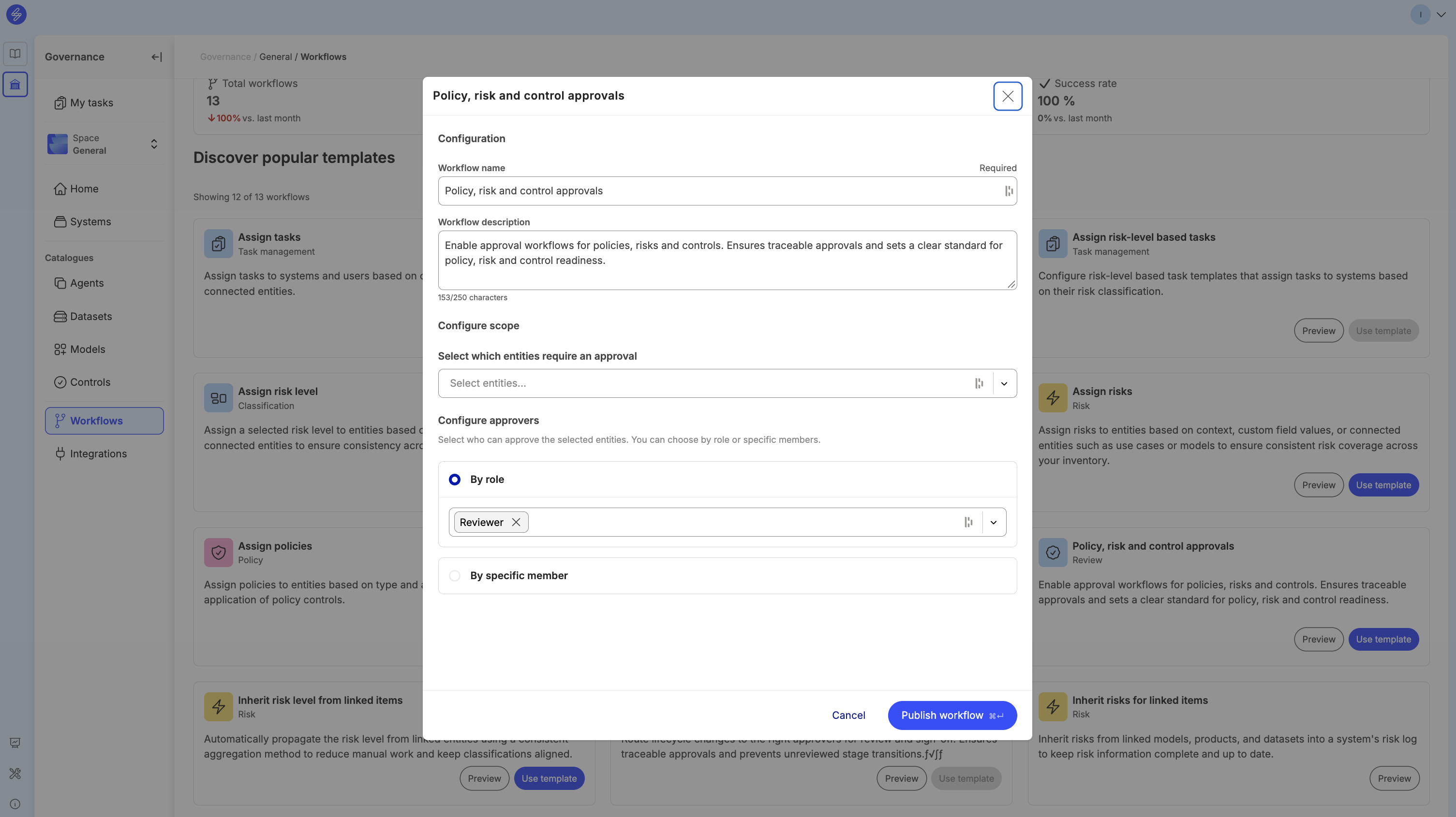
The approval capability is then added to policies, risks and controls based on configuration.
Inherit risk level from linked items
This automated workflow allows you to automatically propagate risk-levels from linked entities using a consistent aggregation method to reduce manual work and ensure alignment.
What this automations does
-
Inherits an entity’s risk level from linked components with assigned risk levels
-
Applies a configurable risk aggregation method (e.g. maximum, majority)
-
Optionally allows manual override of the inherited risk level, with overrides recorded in the audit log

Once the automation is enabled, it will allow risk level inheritance from components to AI systems. More information about this can be found here.

More information about how to set component specific risk classification:
-
Agent or Tools risk classification
Inherit Controls to existing risks
This workflows allows you to automatically assign relevant controls from the control catalogue to systems based on linked risks, ensuring consistent mitigation and reducing manual effort.

Assign controls to entities
This workflow allows you to assign relevant controls to systems. Controls can be assigned to all systems in the space or systems that meet specific criteria. You can search for relevant controls from all sources, from your own Control catalogue or by filtering to risk and provider controls more specifically. This feature can be for example used to push provider specific controls to all systems with linked models from those providers.

The controls are assigned only to systems whose attributes meet criteria you define. New or updated systems are evaluated automatically.

Assign risks to entities
This workflow allows you to assign selected risks to entities, including systems, models, datasets, agents and tools. Risks can be assigned to all systems in the space or systems that meet specific criteria. The risks are assigned only to systems whose attributes meet criteria you define. New or updated systems are evaluated automatically.

Assign policies to systems
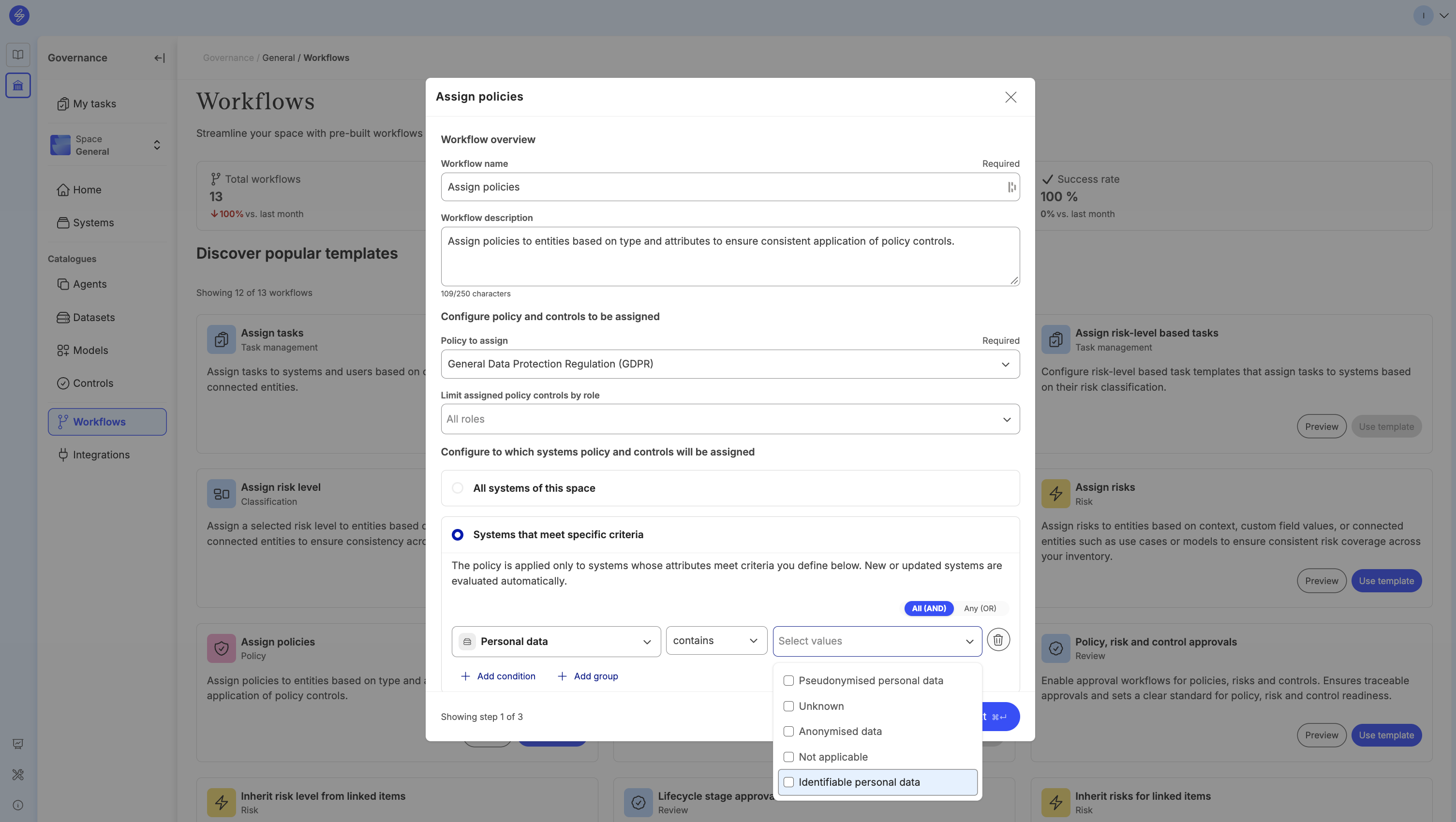
This workflow allows you to assign selected policies to systems. Policies need to be activated in the Control Catalogue first to be available for this workflow build. Workflow can be created to both Saidot enabled Policies and to company specific Custom policies. Policies can be assigned to all systems in the space or systems that meet specific criteria. The policies are assigned only to systems whose attributes meet criteria you define. New or updated systems are evaluated automatically.
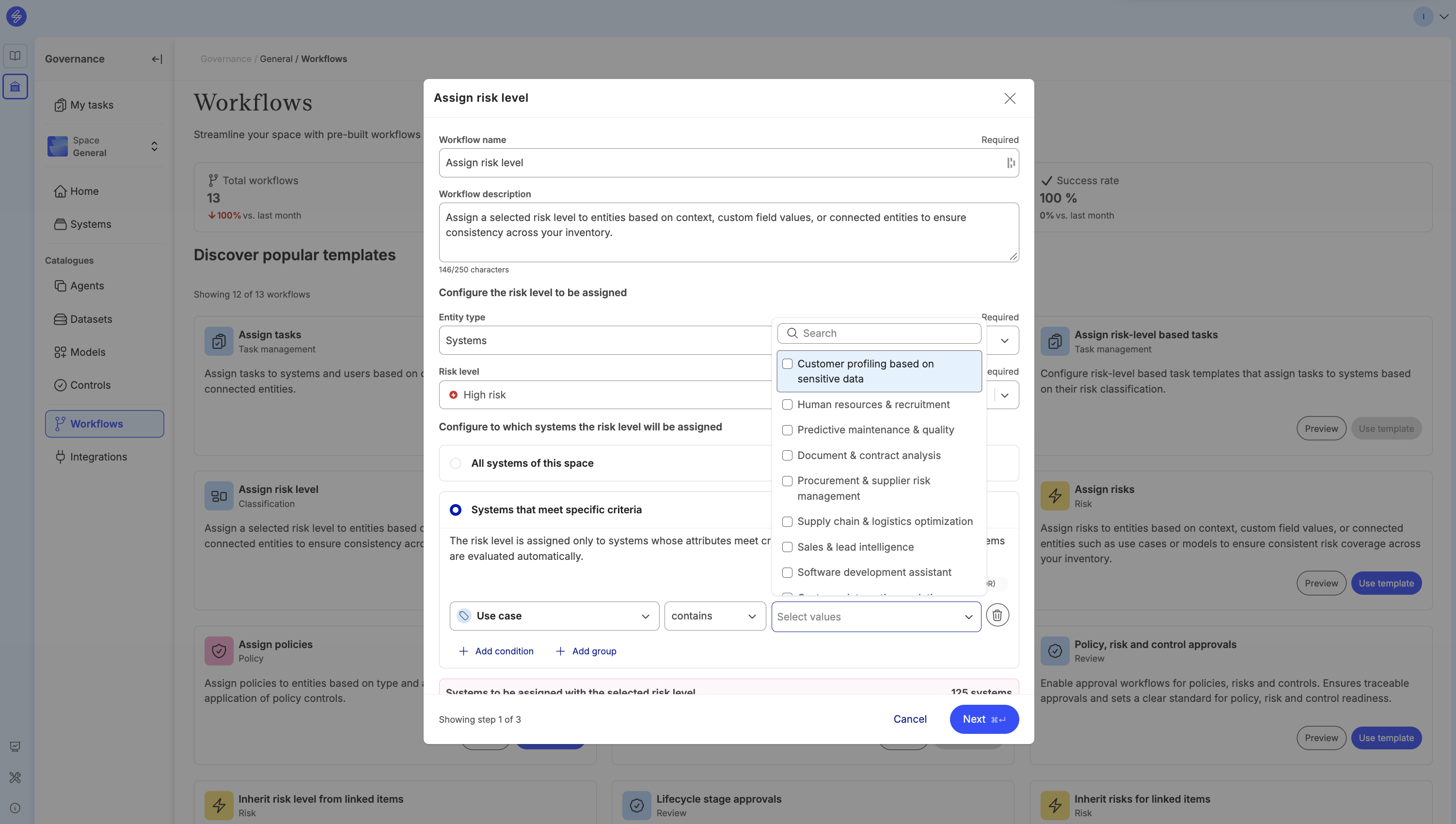
Assign risk level to systems
This workflow allows you to assign the risk level to entities, including systems, models, datasets, agents and tools using Context field values and company-specific Custom fields as risk tiering questions. The risk levels are assigned only to systems whose attributes meet criteria you define. We recommend to create separate workflows for each risk level you want to automate. New or updated systems are evaluated automatically.